


Russia - The Sunday Times World Library
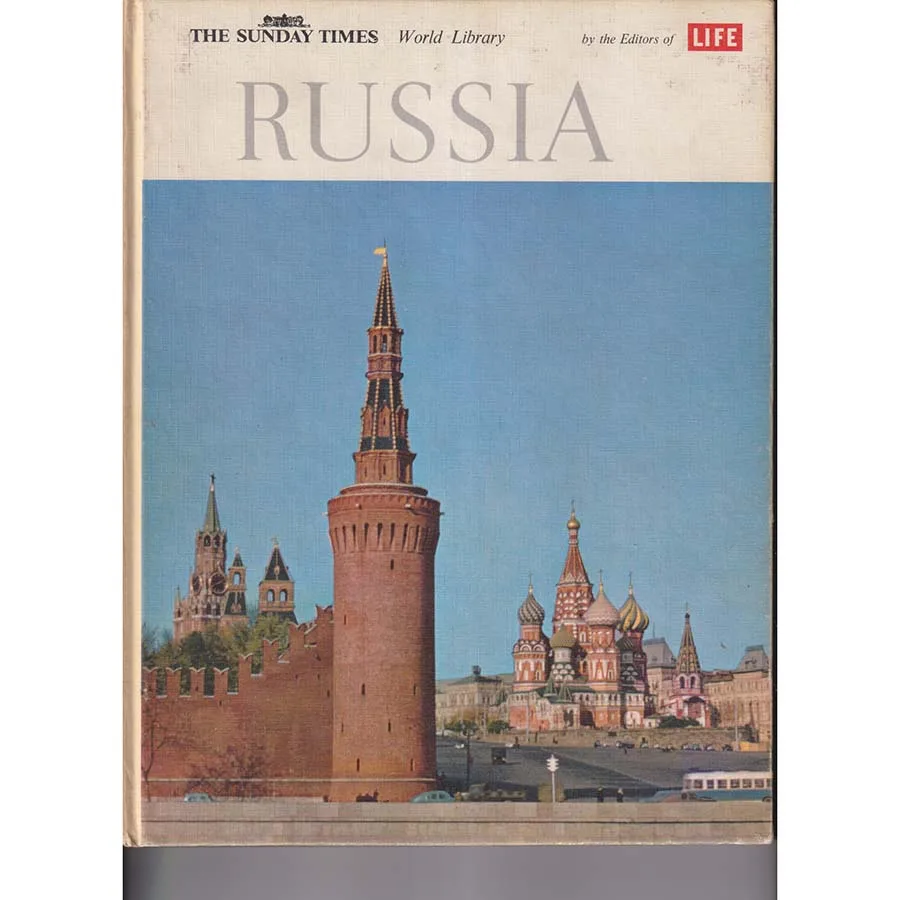
Publisher: The Sunday Times
Format: Hardback
ISBN: none
Russia - The Sunday Times World Library (1961) by Charles W. Thayer – The Sunday Times
ISBN: None
Condition: Good
Russia, 1961. Yuri Gagarin had just become the first human being in space, Nikita Khrushchev was banging away at the machinery of the Cold War, the Soviet Union was projecting itself as a technological superpower, and a large proportion of the Western world was trying to work out whether it was about to be impressed, terrified, or both.
Published by The Sunday Times as part of its World Library series, Charles W. Thayer’s Russia is a wonderfully serious attempt to explain the Soviet Union to a British readership at one of the most dramatic moments of the twentieth century.
And it certainly had plenty to explain.
This is not modern Russia. It is the USSR, sprawling across eleven time zones, stretching from Europe to the Pacific and incorporating an extraordinary variety of peoples, landscapes, climates and republics under one enormous political system.
It was a country that could launch a man into orbit while large parts of the population still lived in conditions that looked decidedly less futuristic.
A country of grand ideological claims, huge industrial projects, collective farms, enormous cities, vast forests, frozen wilderness and government buildings apparently designed on the principle that architecture should intimidate anyone approaching from at least half a mile away.
In 1961, the Cold War was very much not historical background.
The Berlin Wall was built that same year.
The Cuban Missile Crisis was still a year away.
The space race was accelerating.
Nuclear weapons were accumulating with alarming enthusiasm.
And politicians on both sides were periodically explaining that peace was absolutely essential while simultaneously commissioning enough weaponry to remove several continents from active service.
Against that background, books like this were genuinely important.
For the average British reader, the Soviet Union was remote, politically hostile and difficult to visit. Television coverage was limited, travel was restricted and there was no possibility of opening a laptop and spending an evening watching somebody walk around Moscow with a camera.
You learned about Russia from newspapers, radio, documentaries and books.
Preferably substantial books.
With photographs.
Maps.
Statistics.
And an author who had actually been there.
Charles W. Thayer was particularly well suited to the task. An American diplomat, soldier and writer with extensive experience of the Soviet Union and Eastern Europe, he knew the region first-hand rather than merely pointing at it from a desk in London.
That gives the book an additional layer of interest today.
It is not simply a geographical survey but a period interpretation of the Soviet world written by someone who had lived through precisely the political tensions being described.
Naturally, the photographs are now among the most fascinating aspects.
An image of an ordinary Moscow street in 1961 may contain cars, buses, clothing, signs, shops and buildings that have long since disappeared or changed beyond recognition.
A factory presented as evidence of Soviet industrial power may now be abandoned, converted or demolished.
A collective farm that once represented the economic future may have vanished entirely along with the political system that created it.
This is one of the great pleasures of vintage reference books.
The editors carefully photograph the things they think are important.
History then wanders in later and makes entirely different parts of the picture interesting.
The Soviet obsession with industrial development naturally features prominently.
Dams were enormous.
Factories were enormous.
Steelworks were enormous.
Agricultural schemes were enormous.
Even mistakes tended to be organised at a reassuringly enormous scale.
There was a relentless sense that the future could be constructed through sufficient quantities of concrete, steel, tractors and enthusiastic workers standing beside machinery for official photographs.
The cities provide another striking contrast.
Moscow was the political heart of the USSR, filled with monumental architecture, broad avenues and symbols of state power.
Leningrad—now St Petersburg again—carried the weight of imperial history alongside its Soviet identity.
Beyond them lay industrial centres, ancient towns, ports, mining settlements and entire communities created or transformed by central planning.
Then there was the landscape itself.
Russia and the wider Soviet Union covered such an absurd amount of territory that almost every geographical possibility was included somewhere.
Forests vast enough to lose countries in.
Frozen tundra.
Mountains.
Steppes.
Great rivers.
Agricultural plains.
Deserts.
Coastlines on several seas.
And Siberia, a region so large that calling it "remote" feels almost inadequate.
Britain, by comparison, starts to look less like a country and more like somewhere you could accidentally walk across while looking for your car.
One of the most interesting things about reading the book now is knowing what the original reader could not possibly know.
The Soviet Union seemed permanent.
Its rivalry with the United States appeared likely to define international politics indefinitely.
Communism and capitalism were presented as competing systems locked into a struggle that might continue for generations.
And yet the USSR would disappear completely only thirty years later, in 1991.
The flags changed.
The borders changed.
The political system collapsed.
Entire republics became independent states.
Buildings, institutions and industries were reorganised.
And shelves full of books explaining "Russia" suddenly became historical documents.
That is precisely what makes this volume interesting today.
It captures the Soviet Union not in retrospect, but while it was still confidently presenting itself as one of the two great powers shaping the future of humanity.
There is no hindsight.
Nobody has added a convenient final chapter entitled "Anyway, This All Falls Apart in 1991."
You are seeing the country as contemporary readers saw it.
That makes even the confident assumptions revealing.
Vintage books like this also demonstrate how differently people consumed information.
Today you can obtain hundreds of articles, documentaries, maps, satellite images and academic papers about Russia before finishing breakfast.
In 1961, somebody bought this book.
Then they read it.
Possibly all of it.
Without once being interrupted by a notification telling them somebody they went to school with thirty years earlier had uploaded photographs of their dinner.
Civilisation had its advantages.
The physical book has the reassuring solidity typical of the period too. The Sunday Times World Library volumes were designed to occupy an actual bookshelf and suggest that their owner possessed a serious interest in world affairs.
Place this beside volumes on Britain, Italy and China and you instantly look like somebody who might reasonably be consulted during an international crisis.
Whether you have actually read them is entirely your own business.
For collectors today, Russia offers several things at once: Cold War history, Soviet social history, geography, politics, photography and early-1960s publishing, all wrapped into one period volume.
It is emphatically not a modern guide.
Do not use it to plan a holiday.
Do not rely on it for current borders.
Do not telephone any number printed inside.
And if it gives advice about international relations, perhaps compare it with something published after the invention of the internet.
But as a snapshot of the Soviet Union at the height of the Cold War, it is wonderfully evocative.
Condition: Good. A vintage copy showing the normal signs of age and previous ownership expected from a book published in 1961, but remaining in good overall condition and suitable for reading, collecting or leaving conspicuously on a coffee table so visitors believe you spend your evenings contemplating Soviet agricultural policy.
A fascinating survivor from an age when Russia was part of a superpower that seemed permanent, humanity had only just entered space, and the possibility of nuclear annihilation somehow coexisted with extremely respectable illustrated books about geography.
Sold by Crappy Old Books, where the Cold War may be over, but the books stubbornly refuse to acknowledge it.
Keep browsing: See more Travel books Other books by Charles W Thayer
